
All projects
Today, as digital technology becomes deeply embedded in daily life, "attention" has evolved into a scarce resource—contested for, quantified, and commodified.
The constant bombardment of algorithmic feeds, infinite scrolling streams, instant messaging tools, and social media continuously reshapes human cognitive patterns and behavioral habits.
Against this backdrop, the mixed-media installation "The Institute of Attention Economics" attempts to use spatial narrative and participatory experience to construct a critical dialogue about the alienation of attention.
The exhibition does not provide answers. Instead, it uses an immersive environment as a container, inviting the audience to re-examine the power dynamics between the individual and technology within the tension of "being distracted" and "active focus".


The Attention Crisis under Technological Domination
Since Herbert Simon introduced the concept of the "attention economics" in the 1970s, there has always been a profound and unbridgeable gap between human information-processing capacity and the accelerating speed of information explosion.
In the mobile internet era, this gap has been strategically exploited through the collusion of capital and technology, transforming it into a profit-generating mechanism, every user click, swipe, and moment of engagement is precisely captured and converted into quantifiable units of attention.
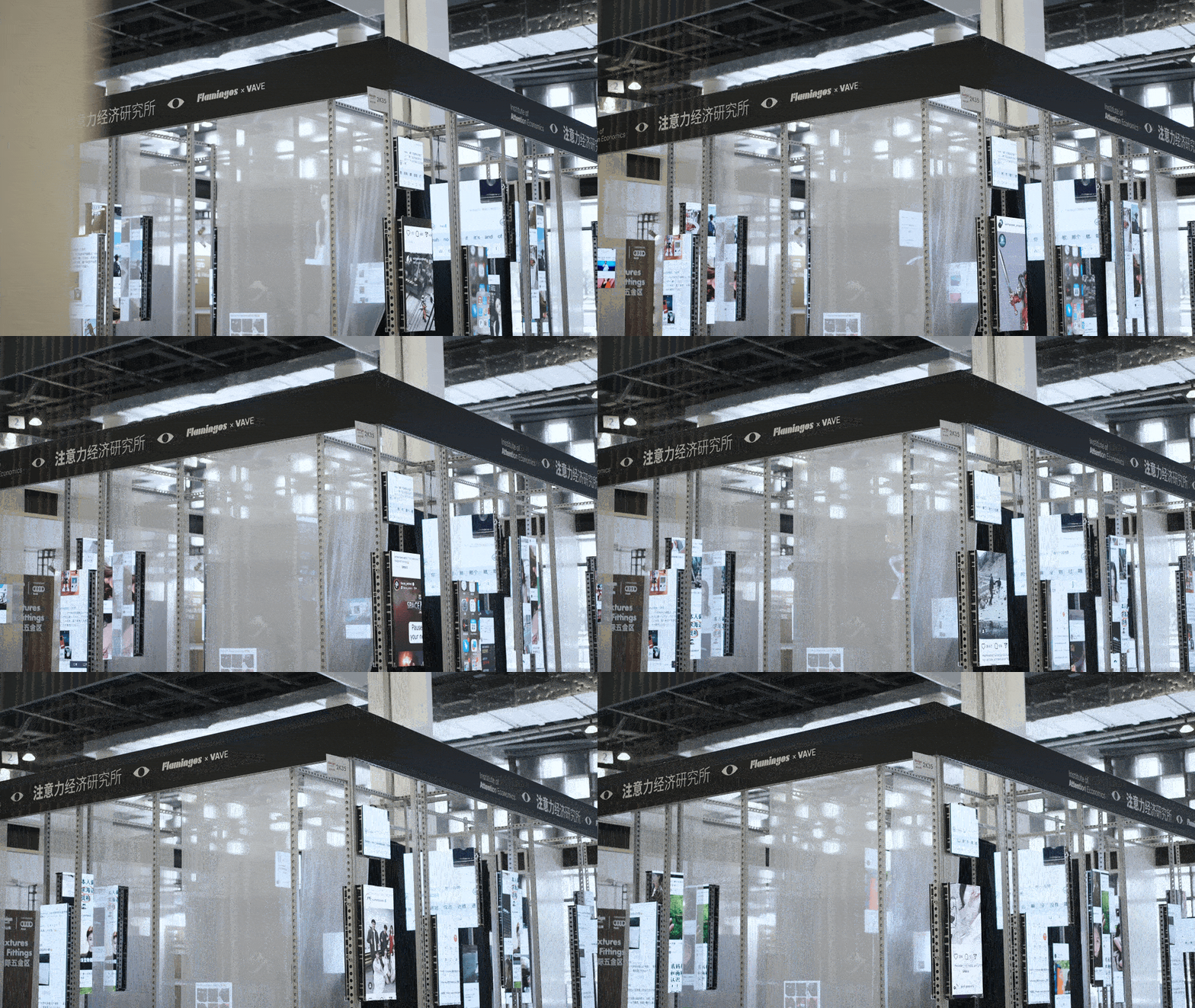
Naming the project "Institute," VAVE constructs the exhibition space as a micro-societal laboratory: an external "jungle" composed of aluminum alloy frames and fragmented LED screens metaphorically represents the systematic siege of human attention by technological infrastructure.

Brain Fog in Mobile Internet Era © Midjourney
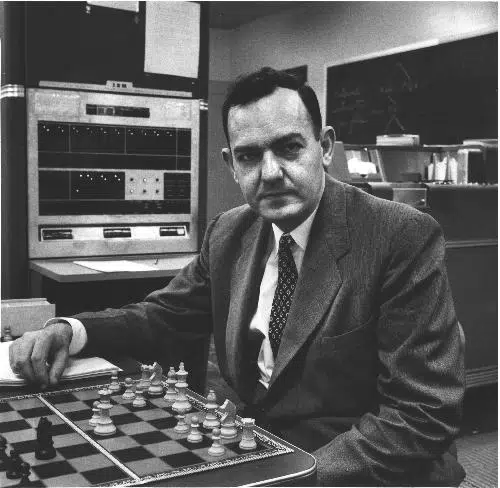
Simon, H. A. (1978 Nobel Laureate in Economics) © 2025 Computer History Museum
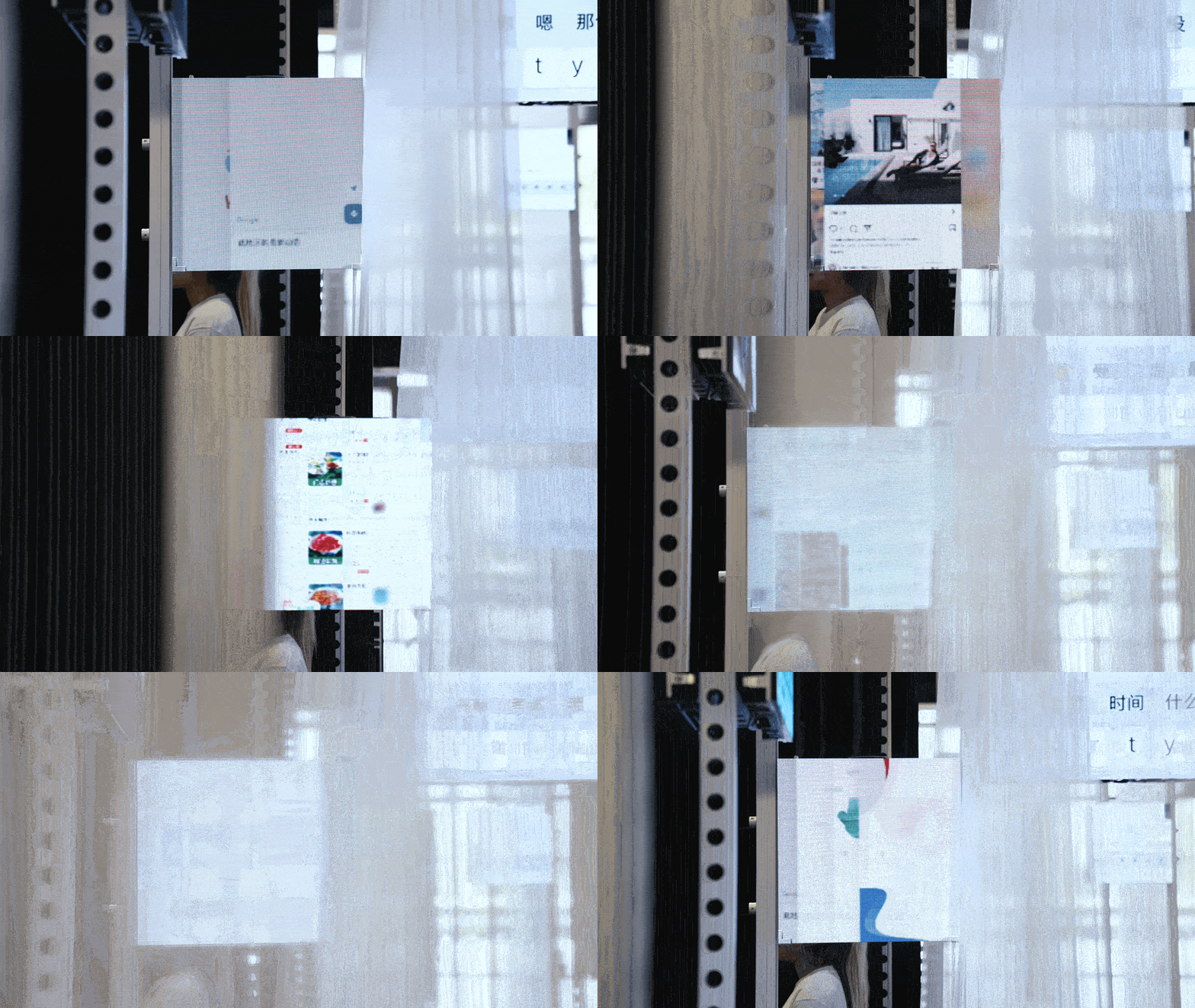
The dynamic content displayed across 198 uniquely shaped LED screens originates from screen recordings of randomly selected visitors' smartphone interactions.
These accelerated sequences, rapid interface switching, endless short-video scrolling, and parallel multitasking scenarios, collectively form a cognitive portrait of digital natives. The artist intentionally preserves the shakes and glitches from operational errors in the recordings, exposing the inevitable anxiety and fragmentation inherent in modern multithreaded information processing.
The mechanical arrangement of the screen matrix implies the cold, calculated order of algorithmic recommendation logic, seemingly free browsing behaviors are, in reality, disciplined outcomes shaped by traffic distribution mechanisms.

Spatial Confrontation: The Cognitive Migration from Noise to Silence
The core tension of the exhibition manifests through a duality of physical spaces: the sensory overload of the external "information jungle" stands in stark confrontation with the extreme restraint of the interior black-draped chamber.
This binary structure does not merely present a simplistic critical contrast, but rather reconstructs two potential states of existence available to individuals within the attention economics, passive immersion or active withdrawal.

Upon entering the external space, visitors are immediately enveloped in the intense glow of LED screens and an immersive surround-sound environment. The artist intentionally creates a sensory dissonance, desynchronizing screen flicker frequencies with asynchronous white noise to replicate the cognitive overload typical in digital realms.
This space functions as a mirror, forcing viewers to confront their unconscious physical responses to daily technology use: rapidly shifting pupils, conditioned reflexive swiping gestures, and transient mental paralysis induced by information saturation.


The act of passing through the black fabric curtain constitutes a micro-ritual. Within this enclosed space of less than six square meters, sensory deprivation is achieved through physical isolation techniques (sound-blocking headphones, light-absorbing textiles), thrusting the participant into a pre-digital mode of interaction.
At the center of the space stands the "Pick-up Sticks" installation, a classic physical game from the 1990s that demands millimeter-precise hand control and sustained concentration.
Here, the artist introduces a media archaeology perspective: as wooden sticks replace touchscreens, and the clatter of falling sticks supersedes push notification chimes, the physical gestures simplified by digital interfaces into mere "swipe-feedback" mechanisms are compelled to return to their biological essence, the fine calibration of muscle movement, the autonomous regulation of breath, and the linear projection of attention.


Participation as Reflection: Reclaiming the Agency of Attention
The radical nature of this exhibition lies in its refusal to let the audience remain passive observers. The transition from being a "spectator" in the external space to an "active operator" in the internal chamber creates a forced trigger for cognitive shift.
When visitors don the noise-cancelling headphones, the act of severing auditory connection with the outside world symbolically recreates digital natives' daily struggle against the information deluge, from enabling "Do Not Disturb" mode to using focus-enhancing apps like Forest, representing individual attempts to seek self-preservation within the technological framework.
Yet through the intervention of the physical game, the artist suggests an alternative possibility: perhaps only by completely breaking away from the closed logic of digital interaction can we temporarily reclaim the cognitive territory colonized by technology.


The arrangement of the "Pick-up Sticks" game is profoundly significant. This activity, demanding intense concentration and fine motor control, essentially functions as micro-training for attention: the scattered sticks metaphorically represent our fragmented cognitive state, while the process of retrieving them one by one requires participants to gather their scattered focus back into a continuous flow of energy.
Notably, most participants exhibit clear initial discomfort, trembling fingers, accelerated breathing, frequent mistakes, physiological responses that reveal how a nervous system long-accustomed to instant feedback mechanisms demonstrates functional regression when confronted with slow, linear tasks.

A Dialectical Perspective on Technological Critique
The profound value of “The Institute of Attention Economics” lies in its avoidance of the black-and-white trap of technological pessimism. The artist deliberately refrains from positioning digital technology and traditional media as simple opposites, instead using spatial narrative to reveal the cognitive ecology co-shaped by both: while the content displayed on the external LED screens originates from smartphone interactions, the screens themselves remain technological artifacts; similarly, the "de-technologized" experience within the inner space still relies on modern devices like noise-cancelling headphones to achieve its effect.
This paradoxical juxtaposition suggests that contemporary existence is inevitably situated within the interstices of technology, complete disconnection has become utopian. The crucial issue, therefore, lies not in rejecting technology, but in reconstructing individual agency over attention.


The Public Experiment: From Individual Experience to Collective Mirroring
As a work emphasizing public participation, The Institute of Attention Economics establishes a nuanced mapping between individual experience and collective behavior. Each visitor entering the "Institute" becomes a performer, their smartphones transforming into props that weave them into a theatrical production named "Attention." This configuration subtly mirrors the collective unconscious of the social media era, that we are simultaneously victims of the attention economics and its unwitting accomplices.


Cognitive Archaeology in Artistic Practice
The Institute of Attention Economics is, at its core, an archaeological practice tracing the evolution of attention. Through the deliberate spatiotemporal dislocation created by its spatial installations, the artist juxtaposes our technologically accelerated, alienated cognitive present with pre-digital interaction prototypes, attempting to awaken viewers' bodily memory through this contrast. When a wooden stick is carefully extracted from the chaotic pile of game rods, this action can be read as a potent metaphor: amidst the ruins of information explosion, can we retrieve the lost essence of focused attention?
The exhibition offers no utopian solutions, but the experiential loop it constructs, from forced distraction to active focus, from data deluge to physical touch, opens a fissure for the viewer. Through this crack, we glimpse a cognitive world untouched by traffic metrics: a world where time need not be sliced into algorithm-friendly content units, and attention carries no CPM (cost per mille) price tag. This very act of glimpsing may itself mark the beginning of resistance.
Credits
Concept Design & Content Planner
VAVESTUDIO
Venue Partner
Design Shanghai
Sponsor
Flamingos
Creative Director
Hu, Haijie
Technical Director
Junlei Zhou
Space Design
Boxuan Zhao
Communication Design
Oly Wang
Digital Content Production
Shunkang Lin
Acoustic Consultant
Frank Fu
AVL Device Consultant
Junlei Zhou
Project Implementation & Structure Consultant
Flamingos
Photo- & Videographer
The Stare Odyssey Inc.


